
 한국어
 English
 繁體中文
 Монгол хэл
Korea EVO ICL Candidate Portal: Who Actually Qualifies? Cost, Reviews and Methods
An online EVO ICL candidate check screens your age and prescription. Whether a lens fits inside your eye depends on chamber depth, corneal cell count and lens sizing, which only an eye exam measures.
Wondering whether a Korea EVO ICL candidate portal can tell you, before you book a flight to Seoul, if your eyes really qualify for a lens implant?
Read this before you fill in one more online form.
You'll know what an online check can and can't screen, which four measurements decide candidacy, what decides the cost, what reviews get right and wrong, and which methods remain if ICL isn't the fit. That should tell you whether a trip makes sense for your eyes and your budget.
Hello, I'm Dr. Lee Ki-il, Medical Director and ophthalmologist at OLIM Eye Clinic in Gangnam, Seoul.
I'm a full member of ASCRS and KSCRS and an adjunct professor at Seoul St. Mary's Hospital, The Catholic University of Korea College of Medicine. At OLIM I review your test results and explain them to you myself, and our comprehensive eye exam runs about 60 tests, including glaucoma, retina and dry eye checks.
I wrote this because a "likely candidate" result from an online quiz is easy to read as a green light, and the numbers that matter most for a lens implant can't be typed into a form.
A candidate portal screens your age and prescription. The space inside your eye, the cells lining your cornea and the lens size you'd need come only from measuring the eye itself.
If you have a recent glasses or contact lens prescription, send a photo of it on WhatsApp with your age, and add the one question the quiz left you with.
Your numbers decide itSend a photo of your prescription or eye exam report. The doctor reviews it.
What can a Korea EVO ICL candidate portal actually check?
Most online candidate checks ask the same handful of things: your age, your prescription, whether it has changed lately, whether you've been told your corneas are thin, and sometimes whether you have other eye conditions. Those are real filters. If you're 19, or your myopia is minus 1.5, a form can tell you correctly that this lens wasn't designed for you.
What a form can't do is see inside your eye. An ICL sits behind the iris and in front of your natural lens, in a space measured in fractions of a millimeter. Whether that space is large enough, and whether a lens can be sized to it, only an exam answers. So read a "yes" from a portal as "worth measuring" and nothing more.
Outside those ranges, the useful question becomes which other approach suits your eyes.
The four measurements that decide candidacy
When I look at results for a lens implant, four numbers carry most of the weight. None of them can be self-reported.
| Measurement | Why it matters for an ICL |
|---|---|
| Prescription stability | A prescription still moving by a meaningful amount means the correction aims at a moving target |
| Front chamber depth | A shallow space leaves less room for the lens and for fluid to drain, which is linked to raised eye pressure |
| Endothelial cell count | These inner corneal cells keep the cornea clear and don't regenerate, so a low starting count is a reason to stop |
| Lens sizing | The internal width of your eye decides the lens length; a poor fit can crowd the drainage angle or sit too close to your natural lens |
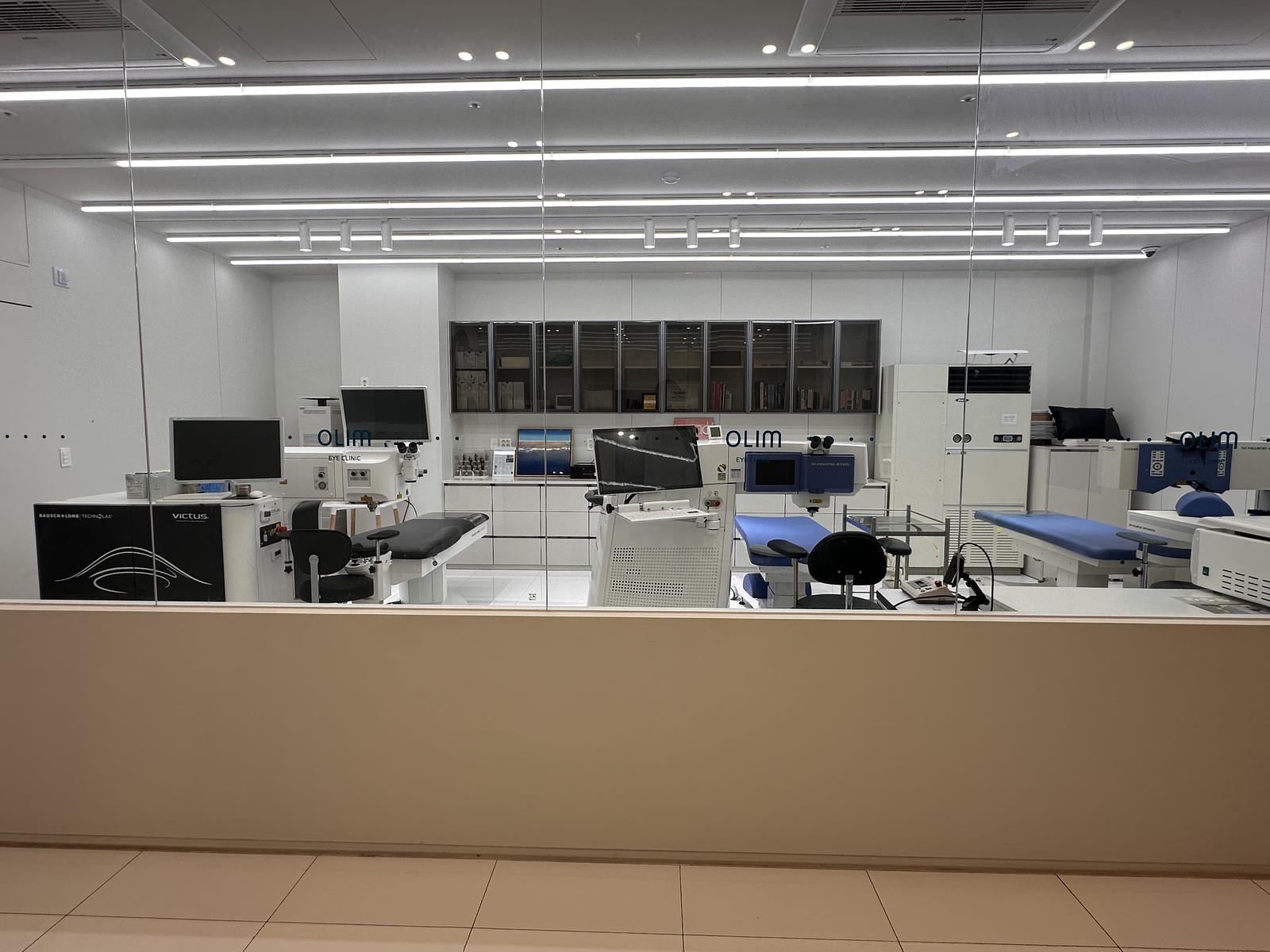
Bring old prescriptions if you have them. The history tells me more than today's number alone. A Scheimpflug camera such as the OCULUS Pentacam, which I have among the clinic's 23 devices, maps the cornea and the front of the eye; the IOL Master 700 measures the eye's length and dimensions.
Two more things sit in the background. Pupil size in dim light affects how noticeable halos are at night. And highly short-sighted eyes are generally more prone to retinal thinning, so the retina deserves a careful look before any lens goes in. Our retina exam uses OPTOS and OCT imaging.
Over 40 and short-sighted: does an ICL still make sense?
Say you're 44, around minus 9 with some astigmatism, you've worn contacts for twenty years, and the portal said you're a likely candidate. You're inside the approved age range, just. The first thing I'd ask is whether your reading distance has started to drift.
An ICL corrects distance. It does nothing to stop the natural lens from stiffening with age, which the American Academy of Ophthalmology describes as presbyopia, usually noticed somewhere in your 40s. So reading glasses arrive on their own schedule. Presbyopia surgery is possible in your 40s and 50s even without a cataract, and I'd rather people consider it before the 60s, when cataract often joins in.
If your chamber depth, cell count and sizing all come back with room to spare, and your near vision hasn't changed yet, ICL can still be a sensible choice at 44. If you're already holding your phone at arm's length, I'd want to lay both paths side by side with your results in front of us, and choose together.
If you're in your 40s, add one line to your WhatsApp message about your near vision, such as whether you've started taking your glasses off to read, and ask whether ICL or presbyopia correction is the one to think about first.
Your numbers decide itSend a photo of your prescription or eye exam report. The doctor reviews it.
What do ICL reviews get right and wrong?
Forum threads and review videos about implantable lenses repeat a few claims. Some hold up better than others.
"It's reversible." Partly true. The lens can be removed or exchanged, but that is a second operation with its own risks, and removal doesn't undo changes such as a cataract that has already formed.
"It's the answer for thin corneas." Often a good reason to look at it. The cornea isn't reshaped, so its thickness limits an ICL far less than it limits laser correction. Thin corneas say nothing, though, about chamber depth or cell count, and those are the ICL's own limits.
"The halos never go away." Many people notice halos or glare around lights at night, especially in the first weeks, and for many they become less bothersome over the following months. Larger pupils in the dark tend to make them more obvious. It is worth asking about before surgery.
"The quiz said yes, so I'm basically approved." This one is wrong. A quiz filters out people the lens clearly wasn't designed for. It can't approve anyone.
Which methods are left if ICL isn't the right fit?
If your cornea is thick enough and your myopia is moderate, laser correction comes back into the picture: 5th-generation SMILE on the SCHWIND ATOS through a 2mm incision, or LASIK and LASEK. Laser options remove corneal tissue, and dry eye is common for some months afterward. I've written separately about how your cornea decides between SMILE, LASIK and LASEK.
If your myopia is beyond what laser can safely remove, a lens implant is usually where the conversation goes. If you've read about EVO specifically, ask about the model by name when you message.
For people in their mid-40s and older, presbyopia correction is the third path. It has its own trade-offs for near focus and night vision, which I'd go through with your results.
What decides the cost of ICL in Korea?
I won't put figures in an article, because the figure for your eyes comes from a handful of factors:
- one eye or both
- whether you need a toric lens for astigmatism, and which lens model
- how many checks you need in Seoul before flying home
- whether your results point to ICL at all, or to a laser or presbyopia option
Ask on WhatsApp what it would cost for your case, with a photo of your prescription.
Planning your days in Seoul
We're on floors 2 to 5 of the Rian Building, 546 Nonhyeon-ro, about 200m from Exit 6 of Eonju Station. Hours are Monday, Tuesday and Thursday 10:00 to 19:00, Friday 10:00 to 19:30 and Saturday 09:00 to 15:00, with lunch from 13:00 to 14:00. We're closed on Wednesday and Sunday. The OLIM Eye Clinic English homepage has the map and contact details.
Registration for exams and surgery closes two hours before closing time. On a Saturday, that means registering by 13:00.
Ask at booking how many days the ICL exam, surgery and post-op checks need for your case, and leave a spare day before your flight. Whatever a Korea EVO ICL candidate portal suggested, the travel plan should follow the exam results.
What can go wrong, and what to do once you're home
Risks and side effects to know
In the first days, a mild ache, light sensitivity, some blur and halos around lights at night are common, and they usually settle over days to weeks. How each eye heals varies from person to person.
The FDA's list of phakic lens risks includes raised eye pressure, cataract, loss of corneal endothelial cells, inflammation, retinal detachment and the need for further surgery to reposition or remove the lens. These are less common, and they are the reason the measurements above matter.
As general medicine, waiting or skipping is usually wiser if your prescription is still changing, if you're pregnant or breastfeeding, if you have glaucoma, recurrent eye inflammation or an active eye infection, or if your chamber is shallow or your cell count is low.
Once you're home, sudden eye pain, redness, blurred vision with halos and nausea can signal a pressure spike, and needs an eye doctor the same day. New flashes, a shower of floaters or a curtain over your vision need urgent care. The CDC's medical tourism advice is to take copies of your records and arrange follow-up care at home before you travel, and that applies here.
When you're ready, the first message can be a single photo of your latest prescription on WhatsApp, with your travel dates and the question no portal can answer: is there enough room in my eye for a lens? When you come in, I go through your measurements with you and recommend the option that fits your eyes, whether that turns out to be an ICL or not.
Frequently asked questions
Is EVO ICL approved for people over 45?
The FDA's 2022 approval covers ages 21 to 45. Past that age, presbyopia and changes in the natural lens become part of the decision, so presbyopia correction is often worth discussing alongside or instead of an implant.
My surgeon at home said my corneas are too thin for LASIK. Does that make me an ICL candidate?
It makes ICL worth looking at, since the cornea isn't reshaped. Candidacy still rests on front chamber depth, endothelial cell count, lens sizing and a stable prescription.
Can an ICL be taken out later?
Yes, the lens can be removed or exchanged, but it is another operation with its own risks, and it does not reverse changes such as a cataract that has already developed.
Should I stop wearing contacts before the exam?
Contact lenses can temporarily change the shape of the cornea and skew measurements. Ask at booking how many days to keep yours out before the exam.
Will I still need glasses after an ICL?
An ICL corrects distance vision. Reading glasses usually become necessary with age because of presbyopia, and some people still use glasses for certain tasks.
Sources
- FDA approves STAAR Surgical's EVO Visian ICL for myopia (2022) · Optometry Times
- Phakic Intraocular Lenses: What are the risks? · U.S. Food and Drug Administration
- What Is Presbyopia? · American Academy of Ophthalmology
- Medical Tourism · U.S. Centers for Disease Control and Prevention
Written with AI assistance from OLIM Eye Clinic Gangnam's published information and the medical sources listed below. This article is general medical information and does not replace a diagnosis. Whether and how to operate is decided after an in-person exam.