
 한국어
 English
 繁體中文
 Монгол хэл
Korea EVO ICL Procedure Steps in Order: Is the Lens Right for Your Eyes? Cost, Reviews and Recovery
ICL runs in a fixed order: a contact lens break, detailed measurements, lens sizing, a short operation under numbing drops, then same-day, next-day and later checks. The measurements decide whether a lens fits your eye at all.
Told your corneas are too thin for laser, and now trying to work out the Korea EVO ICL procedure steps in order before you commit to a flight?
Give this ten minutes before you book anything.
By the end you'll know each step from the first measurement to the first checkup, what decides the cost, which review claims hold up, and what recovery asks of your days in Seoul. That should tell you whether a lens fits your eyes, your leave and your budget.
Hello, I'm Dr. Lee Ki-il, Medical Director and ophthalmologist at OLIM Eye Clinic in Gangnam. I'm an adjunct professor at Seoul St. Mary's Hospital, The Catholic University of Korea College of Medicine, and a member of ASCRS and KSCRS, the cataract and refractive surgery societies in the US and Korea.
The implantable lens I use at OLIM is ECHO ICL, which corrects very high myopia, astigmatism and even hyperopia. I review your test results and explain them to you in person, and after surgery we keep monitoring your eyes with regular checkups.
I'm writing this because step lists online make ICL look like a twenty-minute operation. That hides the part that decides whether it's safe for you: the measurements taken before anyone talks about a surgery date.
In short, you stop contact lenses, have a full set of measurements, and choose the lens size and power with your surgeon. On surgery day the eye is numbed, the folded lens goes in through a small incision and settles behind the iris, and most surgeons check you that day, the next day and over the following weeks.
If a surgeon at home already said no to laser, send a photo of that exam report on WhatsApp, along with the one reason they gave you. Your own numbers make a better first question than a general one.
Your numbers decide itSend a photo of your prescription or eye exam report. The doctor reviews it.
Korea EVO ICL procedure steps in order, from first exam to first checkup
Most ICL surgeons follow this sequence, wherever they work. The gaps between steps vary by surgeon and lens, so treat them as questions for your booking.
- Contact lens break. Contact lenses slightly reshape the cornea. Many surgeons ask you to stop soft lenses for several days to a week before measurements, and rigid lenses for longer. Ask how long applies to your lens type.
- Detailed measurements. Refraction, corneal maps and thickness, the depth of the space in front of your natural lens, the width of the eye, the endothelial cell count, eye pressure, and a dilated look at the retina.
- Lens planning. The lens power and size are chosen from those numbers, with a toric lens if you have significant astigmatism.
- Iris opening, only for some designs. Older lens designs needed a tiny laser opening in the iris beforehand so fluid could flow around the lens. Designs with a central port generally don't. Ask which applies to the lens planned for you.
- Surgery day. Dilating and numbing drops, sometimes light sedation, a small incision at the edge of the cornea, then the folded lens is injected and positioned behind the iris.
- Same-day pressure check. Eye pressure can rise in the first hours, so many surgeons check it before you leave.
- Next-day check, then follow-ups. Vision, pressure and the lens position are checked the next day and again over the following weeks.
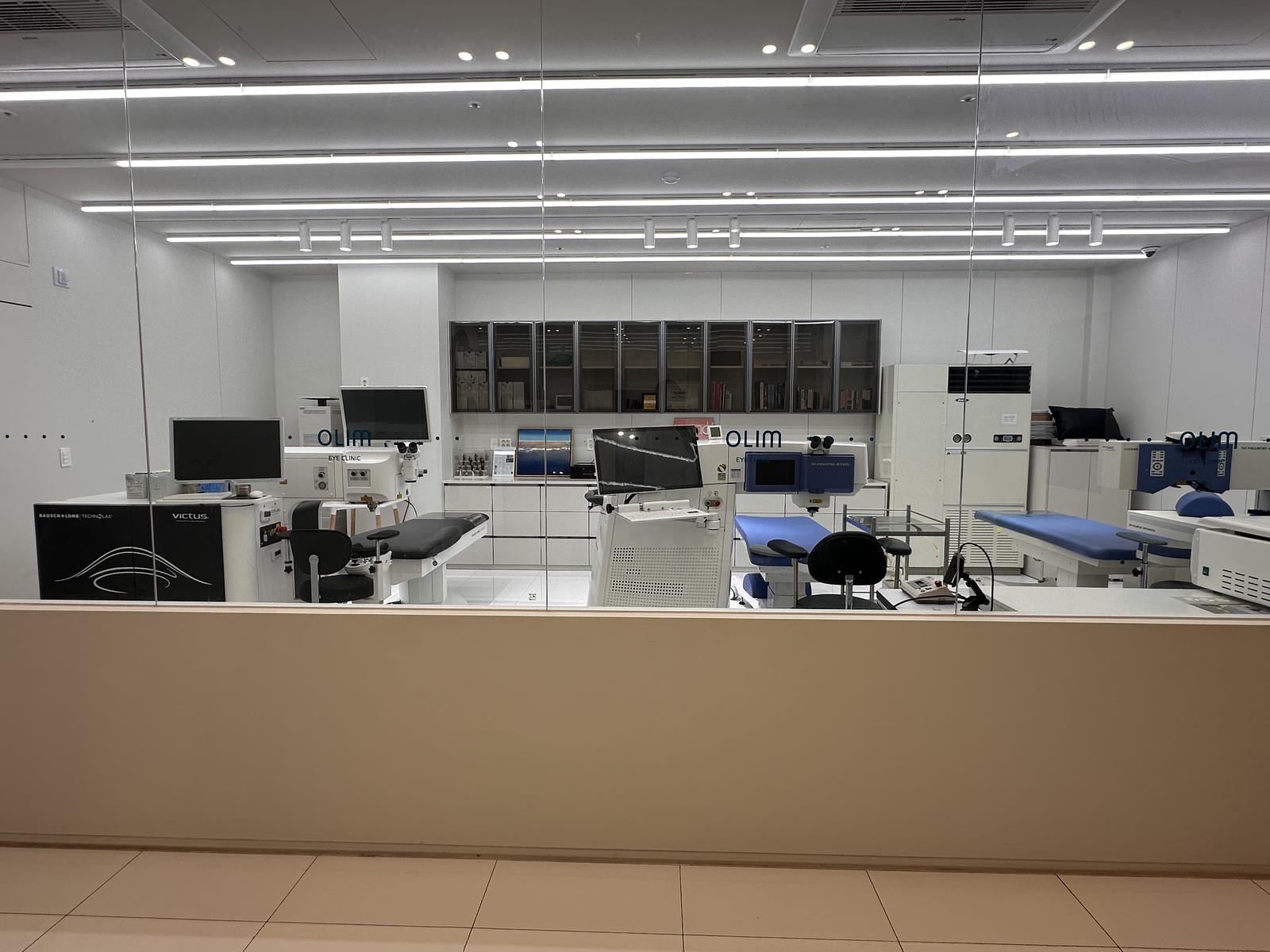
At OLIM, you check in at reception for pre-op exams, the detailed exams are done in order, and then you sit down with me to go through the results. There's a separate space to wait and get ready before surgery.
Why do the measurements matter more than the minutes in surgery?
Because the lens has to fit a space you can't see. An ICL sits in a narrow gap between the back of the iris and the front of your own lens, and the right size depends on the dimensions of that gap.
Think of fitting a shelf into an alcove you can only measure, never look into. A lens that is too large pushes the iris forward and can crowd the channel that drains fluid from the eye, which raises pressure. A lens that sits too close to your natural lens may, over years, raise the chance of a cataract. The space between the two is called the vault, and it is checked after surgery for that reason.
The second number I look at is the endothelial cell count. These cells line the inside of the cornea and pump fluid out of it, and they don't grow back. An implant inside the front of the eye can add to their gradual loss, which is why the US Food and Drug Administration lists endothelial cell loss among the risks of phakic lenses, alongside raised pressure and cataract. A low starting count is a reason to stop.
Your prescription alone doesn't answer that question; the measurements do.
EVO ICL or ECHO ICL: does the brand change the steps?
The lens I implant at OLIM is ECHO ICL. Both are lenses placed behind the iris, and the sequence above applies to both in outline.
Where designs differ, for example whether an iris opening is needed first, ask about the specific lens you'd receive. A forum thread about one brand doesn't automatically describe another.
ICL isn't the only route. If your cornea has enough thickness for your prescription, laser may be an option, and I've written about how your cornea decides between SMILE, LASIK and LASEK. Lens surgery enters the conversation when removing more corneal tissue would be the wrong trade, since laser on a cornea that is too thin for the correction can weaken it over time.
Who the lens suits, and when I'd say no
ICL usually suits adults with high myopia, with or without astigmatism, whose prescription has been stable for a year or more and whose corneas are thin for laser. It needs enough depth inside the front of the eye and a healthy endothelial count.
I would hold off or say no when the front chamber is shallow, the endothelial count is low, the prescription is still changing, there is glaucoma or active inflammation in the eye, or during pregnancy and breastfeeding, when prescriptions often shift.
Say you're minus 11 with 2.50 of astigmatism, you've worn soft toric contacts since your teens, and a surgeon at home told you your corneas are too thin for laser. The thin cornea doesn't rule out ICL, because the lens leaves the cornea in place. What I'd want to know next is the depth inside your eye and your cell count. Your astigmatism means a toric lens, which has to sit at the right angle, so the next-day check matters more for you. If the chamber turned out shallow, I'd tell you ICL isn't the answer on this trip either.
If you're weighing this, send two things on WhatsApp: the dates you could be in Seoul and whether you wear soft or rigid lenses. Your lens type tells you how early the contact lens break has to start before those dates.
Your numbers decide itSend a photo of your prescription or eye exam report. The doctor reviews it.
What decides the cost of ICL for your eyes?
The first factor is whether you're treating one eye or both. The second is the lens itself: a toric lens for astigmatism is a different product from a non-toric one, and some powers have to be ordered for your eye, which can also change how many days you plan in Seoul.
The pre-op measurements and the follow-up visits that fall within your stay are part of the picture too. Most ICL surgery is done under numbing drops, so ask whether any sedation would be used in your case. To get the figure for your own eyes, ask on WhatsApp what it would cost for your case and include your prescription with the astigmatism number.
What do ICL reviews get right, and what do they miss?
"The surgery takes fifteen minutes." The operation on each eye is short, often well under half an hour. The day is longer: drops need time to dilate the pupil, and many surgeons want to check your pressure some hours later.
"It's reversible." The lens can be removed or exchanged, which matters if your eyes change. Removal is still another operation, and anything the first surgery changed, such as an early cataract, doesn't reverse with it. "Removable" is the more accurate word.
"No dry eye, unlike laser." ICL disturbs far fewer corneal nerves than laser, so dryness is often milder. Some scratchiness from the incision and drops in the first days is common.
"Halos at night." These are common early on and, for many people, fade over weeks to months. For some they persist, and a pupil that opens wide in the dark makes them more likely.
What does recovery look like over your days in Seoul?
Vision is usually hazy for the first hours and often much clearer by the next day. Expect some light sensitivity and grittiness, a shield at night for a while, and no rubbing, swimming or eye makeup until your surgeon says so.
Now your calendar. The clinic is open Monday, Tuesday and Thursday 10:00 to 19:00, Friday 10:00 to 19:30 and Saturday 09:00 to 15:00, and closed Wednesday and Sunday. Registration for exams and surgery closes two hours before closing. A surgery on a Tuesday or a Saturday puts the next day on a closed day, so ask how the next-day check would work before you pick that date.
We're on floors 2 to 5 of the Rian Building, 546 Nonhyeon-ro, about 200m from Exit 6 of Eonju Station. Hours, directions and the WhatsApp number are on the OLIM Eye Clinic English homepage.
For the Korea EVO ICL procedure steps in order to finish well, the last step is the one at home. The US CDC's medical tourism guidance advises arranging follow-up care before you travel and bringing copies of your records home. Ask for your measurements and the lens details before you fly, and book an ophthalmologist at home for the checks that come after.
Risks and side effects to know
Common and usually temporary: blurred vision on the first day, glare and halos, light sensitivity and grittiness, which typically ease over days to weeks.
Less common but serious, as the FDA lists them for phakic lenses: raised eye pressure, cataract, loss of endothelial cells, retinal detachment, infection, and a lens that needs repositioning, exchange or removal. Recovery and results differ from person to person, and the in-person exam decides whether the lens is suitable for you.
Who should wait or skip it, as a general rule: anyone whose prescription is still changing, who is pregnant or breastfeeding, who has active eye infection or inflammation, or whose measurements show a shallow chamber, a low endothelial count or glaucoma.
After you fly home, sudden eye pain, redness, worsening vision, or halos with headache and nausea need an ophthalmologist the same day, because they can signal a pressure rise. Take your lens details with you. Over the longer term, periodic checks of the cell count and lens position are worth keeping on your calendar.
Your first message can be a single photo: your glasses prescription or the exam report from home. Add the one question you most need answered, such as "is my eye deep enough for a lens?", and send it on WhatsApp before you book anything. When you come to Seoul, I go through your measurements with you in person, and we choose the treatment that fits your eyes.
Frequently asked questions
Does ICL surgery hurt?
The eye is numbed with drops, and some surgeons add light sedation. Most people feel pressure rather than pain during the operation, then grittiness or mild ache for a day or two afterward.
Are both eyes done on the same day?
Surgeons differ. Many treat the second eye on a separate day so the first can be checked; some do both together. Ask about this when planning your dates, because it changes how long you stay.
How long before the exam should I stop wearing contacts?
Many surgeons ask for several days to a week without soft lenses and longer for rigid lenses, because lenses reshape the cornea and skew the measurements. Confirm the exact break for your lens type at booking.
Can I fly home soon after ICL?
Flying itself doesn't usually harm the eye after ICL, but you need the early checks done first, especially the next-day visit. Plan your return flight around those visits, not around the operation date.
Will I need glasses again later?
ICL corrects your current prescription. Reading glasses can still become necessary with age-related presbyopia, usually from the mid-40s, because that comes from the natural lens, which ICL leaves in place.
Sources
- Phakic Intraocular Lenses: What are the risks? · U.S. Food and Drug Administration
- Phakic Intraocular Lens Implantation for the Correction of Myopia (Ophthalmic Technology Assessment, 2009) · American Academy of Ophthalmology
- FDA approves STAAR Surgical's EVO Visian ICL for myopia (2022) · Optometry Times
- Medical Tourism · U.S. Centers for Disease Control and Prevention
- What Is Presbyopia? · American Academy of Ophthalmology
Written with AI assistance from OLIM Eye Clinic Gangnam's published information and the medical sources listed below. This article is general medical information and does not replace a diagnosis. Whether and how to operate is decided after an in-person exam.